
The Steamer SS Nenana story begins January 2, 1932, in the Marine Digest Magazine when the Alaska Railroad advertised for a sternwheeler to be built. “Bids are Open for a Yukon boat.”

William C. Nickum and Son
William C. Nickum, a Seattle, Washington, Marine Architect, submitted plans for the steam-driven sternwheeler to the Alaska Railroad, which were accepted for the build. The ship was prefabricated in Seattle and shipped up on Steamers. It was then transported 450 miles on the Alaska Railroad to Nenana. It was stipulated that all labor, except skilled mechanics and foremen from the Berg Shipbuilding Company, had to be performed by Alaska territory residents. A total of 35 Alaskan laborers were hired.
The Steamer Nenana was built at the height of the dramatic Alaska riverboat era. It was patterned after the Canadian Klondike, principally a passenger boat; the Nenana was primarily a working vessel and a reflection of American naval architectural design. The ship was a blend of steam, wood, and paddlewheel technology. The sternwheeler was completed in Nenana on May 10, 1933.
The Steamer Nenana carried a variety of mixed freight and food, including fresh vegetables, fresh fruit, dried salmon for dog food, and a wide variety of other small miscellaneous items. Its large refrigeration unit on the lower deck allowed it to haul perishable goods, like milk, eggs, and cheese, to the villages.
In addition to gold, the barges carried coal, lumber, grain, hardware, mining equipment, horses, and dog teams—even the first cars and trucks into the villages.
She ran 24 hours a day from May through September. In the early Fall or during poor weather, a huge searchlight made progress when it was dark.
Due to changing economics and the costs of running the steamer using wood, which was being depleted, they switched the engines in 1948 to oil burning. The boat’s engines had the most advanced design of the time: four 60,000 lb. Fuel oil tanks were installed.
With the end of World War II, there was a surplus of planes available in Alaska. Scheduled flights were starting to fly into the villages. The Alcan Highway built during the war supplied the more significant cities; they no longer used the train to bring in freight from ships. At the close of the 1952 navigation season, she was completely reconditioned at Whitehorse for $164,409.20 to keep the Steamer Nenana competitive. She had to winter over in Whitehorse as the rivers had frozen. She returned to run for one more season in 1953. The age of diesel spelled the finish for the Nenana. The Alaska Railroad, losing money, pulled the SS Nenana from service in 1954.
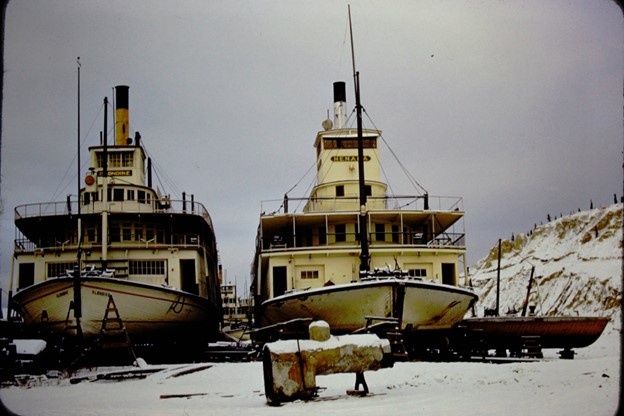
S.S. Nenana in Whitehorse
December 10, 1955, the General Services Administration called for bids to sell the SS Nenana.
In 1956, a group of Fairbanks businessmen formed the Greater Fairbanks Opportunities Inc., an offshoot of the Chamber of Commerce. The Chamber of Commerce was essentially a non-profit group; a method of financing Nenana’s purchase was necessary. Its primary aim was to raise money to promote Fairbanks’ tourist attractions and make the city a high point for Alaska visitors worldwide.
The Chamber of Commerce purchased the Steamer Nenana for $40,000.00 in 1956, then sold it to Greater Fairbanks Opportunities Inc. for $18,893.00. They felt it would more than pay for itself in a few seasons.
They secured 44 acres as the Alaska 67 State Centennial Exposition site and wanted to purchase the Steamer Nenana as the park’s main focal point. In 1965, a channel was dug from the Chena River to a human-made pond that September; the Nenana floated two miles down the Chena into the park as the park’s first structure.
Click to Donated

 Friends of S.S. Nenana Inc.